
It’s 11:47 p.m. and you’re still scrolling. Your shoulders are somewhere up near your ears. You’ve had three tabs open to “how to stop feeling anxious all the time” for a week and you still haven’t clicked on any of them, because who has the bandwidth?
If that sounds like your Tuesday — or honestly, your every day — you’re not broken. You’re overstimulated. And there’s a name for the thing your body has been quietly begging you for: blue space. Time near, in, on, or under water.
Marine biologist Wallace J. Nichols spent decades studying why humans feel an almost involuntary sense of calm near the ocean, and gave it a name that stuck: the Blue Mind Effect. It’s not a wellness buzzword. It’s a measurable, physiological shift — and it might be exactly what your nervous system has been asking for.
- Why proximity to water measurably lowers cortisol, heart rate, and mental noise.
- The real reason your body relaxes near the ocean — it’s called the vagus nerve.
- What chronic “on” mode is actually costing your nervous system.
- Five ways to bring the Blue Mind Effect into your life, starting tonight.
- Why some resets need more than five minutes — and where to find that kind of time.
What Is the Blue Mind Effect, Really?
The Blue Mind Effect describes the mildly meditative state we enter when we’re near water — the ocean, a lake, a river, even the sound of rain. Nichols’ research, along with the neuroscience that followed, found that proximity to water triggers a measurable drop in cortisol, a lowered heart rate, and increased activity in the parts of the brain associated with calm, creativity, and emotional regulation.
In plain terms: your brain doesn’t have to work as hard near water. The repetitive motion of waves, the negative ions in sea air, the horizon line stretching out with nothing demanding your attention — it all adds up to something researchers call “soft fascination.” Your mind stays gently engaged without being taxed, which is the exact opposite of what a notification-filled inbox does to you.

This is different from “feeling blue,” the low mood we borrow the same color to describe. Blue Mind is water-induced calm — and it’s backed by real physiology, not just a nice metaphor.
Why Your Nervous System Is Begging for a Reset
If you’ve spent the last few years feeling like your stress response is stuck in the “on” position, you’re not imagining it. Chronic low-grade stress — back-to-back calls, algorithmic doom-scrolling, never fully logging off — keeps your sympathetic nervous system (fight-or-flight) activated far longer than it was ever designed for.
Your body has a built-in off-switch for this: the parasympathetic nervous system, sometimes called “rest and digest.” One of its main highways is the vagus nerve, which runs from your brainstem down through your heart, lungs, and gut. Activities that stimulate the vagus nerve — deep breathing, cold exposure, humming, and yes, being near or in water — physically shift your body out of stress mode and into recovery mode.
“Water doesn't just feel calming. It gives your vagus nerve something to do besides brace for the next email.
This is where ocean therapy stops being poetic and starts being practical. Floating removes gravitational load from your joints and muscles, which lowers physical tension. Even the color blue itself has been shown in studies to reduce heart rate and blood pressure compared to more stimulating colors like red.
The Cost of Staying “On” (And Why You Deserve Better)
Ocean waves break at roughly 12 to 15 cycles per minute — close enough to a resting breath rate that the sound alone can help entrain your own breathing to slow down.
If you’re a high-achieving professional in your late 20s or 30s, chances are you’ve built a life that looks good on paper and still leaves you exhausted in a way sleep doesn’t fix. Burnout doesn’t always look like collapse — sometimes it looks like this:
- Waking up tired no matter how many hours you slept
- Feeling anxious in your body even when nothing is technically “wrong”
- Craving a vacation that isn’t just a change of scenery, but an actual reset
- Scrolling wellness content for hours without ever doing any of it
- Wanting connection and stillness, but not knowing how to access either
None of that is a personal failing. It’s what happens when a nervous system runs on chronic stress for years without a real recovery period. And here’s the uncomfortable truth: a long weekend at an all-inclusive resort with a swim-up bar isn’t the same as physiological recovery. Your body knows the difference between numbing out and actually downregulating.

How to Bring the Blue Mind Effect Into Your Life
The good news is that you don’t need a plane ticket to start. Blue Mind practices work on a spectrum, and you can meet your nervous system where it’s at.
-
01
Micro-doses of blue space
Even two minutes of looking at water — a fountain, a lake, footage of waves — has been shown to lower stress markers. Keep it in view while you work if you can.
-
02
Cold water resets
A cold shower finish or a plunge into cool water activates the vagus nerve almost instantly, shifting your body out of fight-or-flight in under a minute.
-
03
Ocean or lake swimming
Full-body immersion combines vagal stimulation, rhythmic movement, and “soft fascination” — the trifecta of nervous system regulation.
-
04
Sound therapy
If you’re landlocked, recordings of ocean waves at 12–15 cycles per minute can help entrain breath and heart rate, especially before sleep
-
05
Barefoot beach walking
Combines grounding, gentle cardiovascular movement, and blue space exposure — a full reset in under 30 minutes.
These are real tools. But if you’ve been trying to self-regulate your way out of burnout with five-minute meditation apps between meetings, you already know how far willpower alone gets you. Sometimes your nervous system doesn’t need another hack. It needs an actual, sustained window of recovery.
When Micro-Doses Aren’t Enough: The Case for Immersion
Here’s what the research doesn’t always say out loud: nervous system regulation isn’t just about single moments of calm — it’s about giving your body enough consecutive time in a parasympathetic state to actually recalibrate its baseline. That’s hard to do in stolen five-minute pockets between calls. It’s much easier when the ocean is, quite literally, the view from where you’re doing yoga.

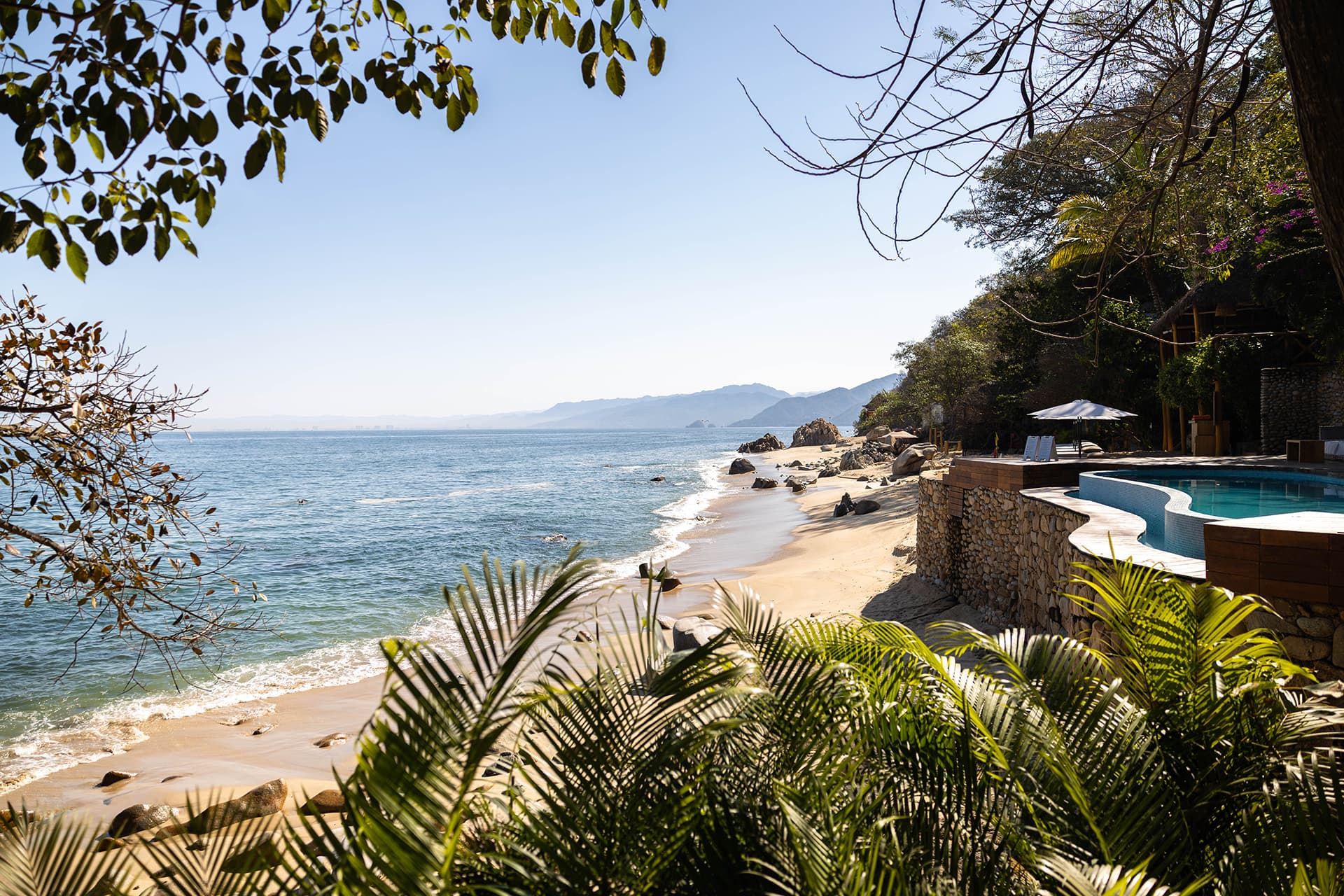
This is the entire premise behind Xinalani’s approach to retreat design. Perched on the jungle-covered coastline of Puerto Vallarta and reachable only by boat, Xinalani was built around the idea that you don’t just need a break — you need an environment where your body can finally exhale. Ocean-view yoga platforms, beachfront meditation, saltwater swimming, and slow mornings without a single notification aren’t amenities here. They’re the actual mechanism of recovery.
You don’t have to choose between a “real vacation” and doing the deep work of restoring your nervous system. At Xinalani, they’re the same thing.
Your Nervous System Isn’t Asking for More Willpower. It’s Asking for Water.
If you’ve made it this far, some part of you already knew this. The pull you feel toward the ocean, the way your shoulders drop the second you see open water, the fact that “beach trip” still sounds better than almost anything else when you’re exhausted — none of that is a coincidence. It’s your biology, quietly asking for what it needs.
You don’t have to overhaul your life to access Blue Mind. You can start tonight with the sound of waves and a cold rinse before bed. But if what you actually need is a real, immersive reset — the kind that comes from days, not minutes, near the water — that’s exactly what a retreat like Xinalani was designed for.
PARADISE IS CLOSER THAN YOU THINK
Your nervous system has been runing the marathon. The ocean is where it finally gets to walk.
Xinalani is 12 miles south of Puerto Vallarta International Airport, on a 250-yard private beach reachable only by boat. Come feel what the research describes.
Explore Retreat DatesOur office hours are from 9am to 6pm (GMT-5).