
of solo travelers worldwide are women
size of the global wellness economy (2024)
of women plan a women-only trip in 2026
of retreat guests report a lasting benefit
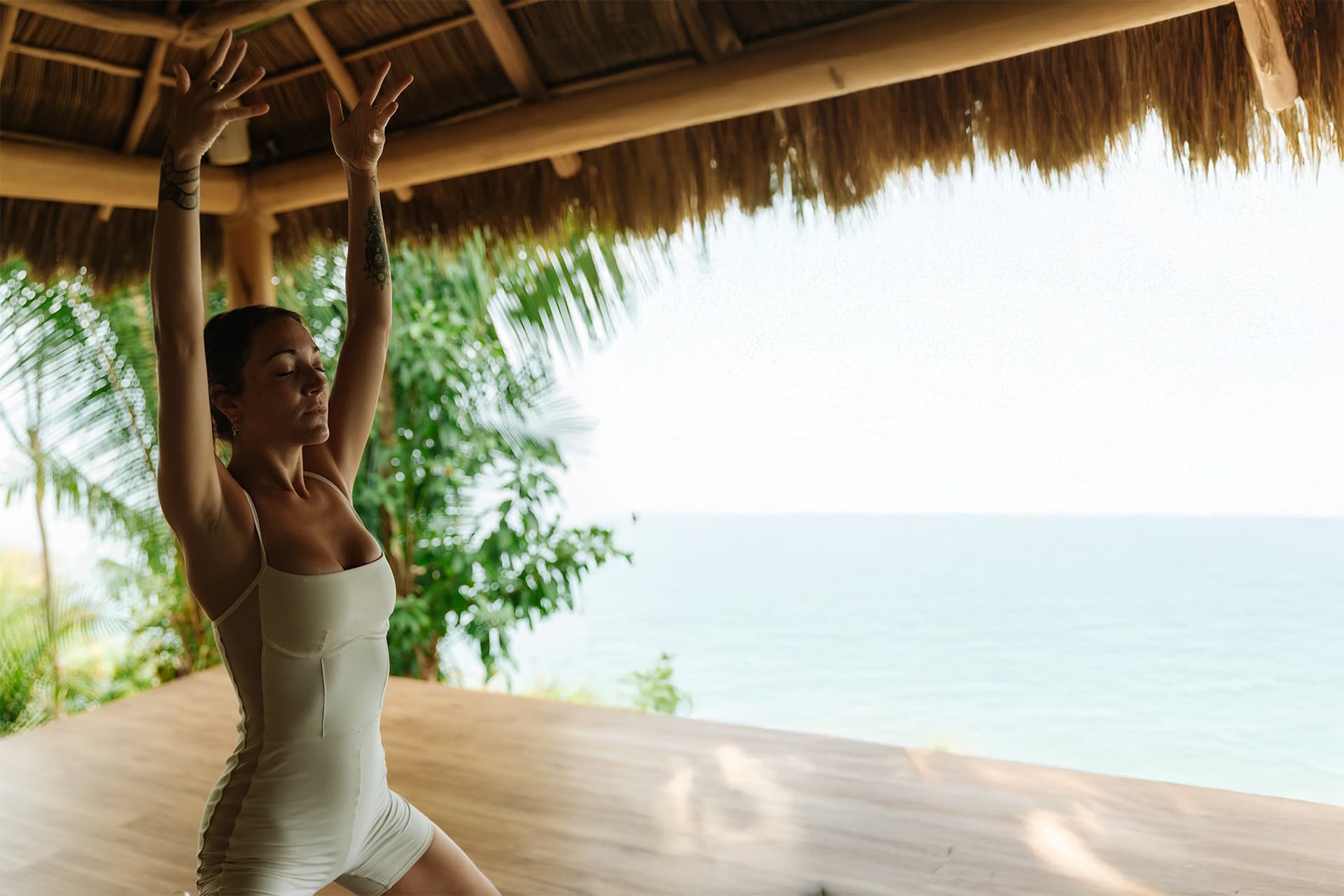
There’s a particular kind of exhaustion that doesn’t show up on a calendar. It’s not burnout you can point to—no single bad week, no one collapse. It’s cumulative: the low hum of always being reachable, always managing something, always slightly behind on rest. For a growing number of women, the response isn’t a beach vacation with friends or a long weekend catching up on errands. It’s getting on a plane alone.
01 — THE SHIFT
Why Women Are Rewriting the Rules of Solo Travel
The scale of this shift is hard to overstate. Women now make up an estimated 75–84% of solo travelers globally, accounting for roughly 54.6% of the solo travel industry’s revenue in 2025, according to Grand View Research. Google search interest in “solo female travel” has climbed roughly fivefold since before the pandemic, with a particularly sharp jump in 2025. And in the Solo Female Travelers Club’s fifth annual survey, published in March 2026, 21% of women said they plan to take a women-only trip this year, a figure that has risen for three consecutive years.
What’s changed isn’t that women suddenly discovered independence. It’s that the reasons for going alone have shifted. A decade ago, solo travel was framed as an act of adventure or defiance. Today, for a large share of women, it’s something closer to maintenance: a deliberate, scheduled response to a life that doesn’t otherwise leave room for recovery.
02 — THE NUMBERS
The Wellness Travel Boom, By the Numbers
Wellness tourism isn’t a niche anymore—it’s one of the largest and fastest-growing segments in global travel. The global wellness economy reached a record $6.8 trillion in 2024, growing 7.9% year over year, according to the Global Wellness Institute’s 2025 Global Wellness Economy Monitor. Within that broader figure, the wellness tourism market alone was valued at roughly $975–990 billion in 2025 and is projected to keep expanding at close to 9% annually through the next decade, according to estimates from GMI Research and Grand View Research.
Two forces are driving that growth in tandem: more people traveling specifically for wellness, and more women traveling alone. Where those two trends intersect is where retreats like Xinalani sit.
The appetite is visible on the ground, too. BookRetreats’ State of Retreats 2026 report found that 78% of respondents were interested in joining a yoga retreat within the next 12 months, and 64% already had one booked. Perhaps more telling: for the first time on record, stress relief has overtaken flexibility as the top reason people say they practice yoga, cited by 51% of practitioners, according to Yoga Alliance. Retreat-goers aren’t chasing a deeper backbend. They’re chasing a nervous system that isn’t constantly on alert.
“Arriving burnt out and overstimulated, today's travelers want to choose how they move, rest, and connect—not have it chosen for them by everyone else's schedule.
That reframing matters because it changes who shows up. A retreat is no longer just for the already-flexible, already-initiated yogi. It’s for the exhausted executive who has never done a single sun salutation and the freelancer who hasn’t taken an unstructured week off in years.
03 — THE HESITATION
Why Traveling Alone Feels Scary (and Why That’s Normal)
If you’ve never taken a trip by yourself, the hesitation isn’t irrational. It’s specific. It usually sounds less like “I’m afraid” and more like a list: Will I feel awkward eating alone? What if everyone else already knows each other? Is it actually safe? What do I even do with unstructured time?
The data backs up how common these concerns are. In the 2026 Solo Female Travel Trends Survey, 68% of women cited personal safety as a top concern, and an equal 68% cited the higher cost of not splitting expenses with a companion. Only about 16% said they’d actually felt afraid for their safety on a solo trip in the past year—which suggests the anticipation is usually worse than the experience. Notably, that fear drops with exposure: among women who’ve taken more than ten solo trips, the share citing safety as a primary worry falls from 72% to 62%.
The more interesting finding, though, is what actually gets first-timers to book. Among women who have never traveled solo, 76% said they’d be more likely to take that first trip if it were structured as a small, women-only group tour rather than a fully independent itinerary. That’s not a coincidence—it’s a design brief. First-time solo travelers aren’t necessarily looking for total isolation. They’re looking for a version of solitude that still has scaffolding around it.
04 — WHAT WORKS
What First-Time Solo Travelers Actually Need
Strip away the marketing language, and most first-time solo wellness travelers are asking for the same handful of things:
- A structure that doesn’t require constant decision-making. After months of managing everyone else’s schedule, the last thing that feels restful is building your own itinerary from scratch.
- Built-in ways to meet people, without pressure to socialize on demand. Community dining tables, group excursions, and shared common spaces work better than forced icebreakers.
- Permission to disconnect. Not just Wi-Fi that technically doesn’t work, but an environment where logging off doesn’t feel like falling behind.
- A setting that does some of the emotional work for them. Nature, ocean, quiet—these aren’t decoration. They’re functionally part of the recovery.
- Enough personal space to actually process the trip, not just move through it.
This is where the difference between a vacation and a wellness retreat becomes concrete.
A vacation is built around seeing things.
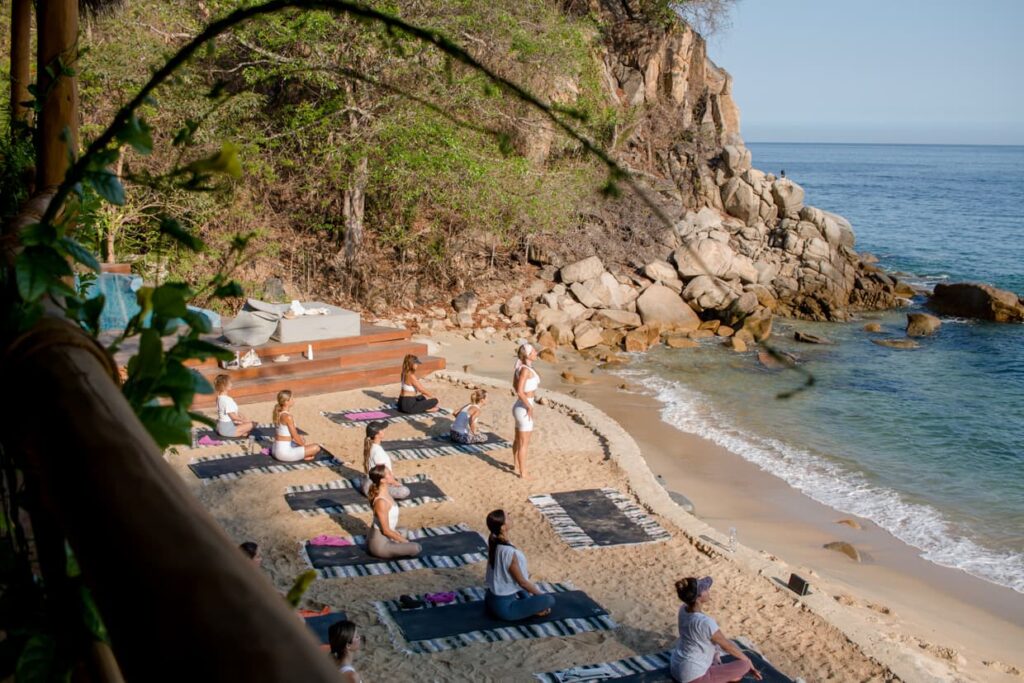
A well-designed retreat is built around a rhythm—morning movement, unhurried meals, open blocks of unscheduled time, evening wind-down—that does the planning for you so your nervous system can actually exhale.
05 — ENVIRONMENT
Why Nature Does What Willpower Can’t
There’s a reason “digital detox” has become one of the defining travel phrases of this decade rather than a passing trend. The 2025 Hilton Trends Report found that more than a quarter of travelers planned to reduce their social media use on their next vacation, and search interest in digital detox retreats has shown sustained, seasonal spikes well into 2026. The Global Wellness Summit named “analog wellness”—the deliberate act of logging off—one of its major industry trends.
What makes a jungle-and-ocean setting particularly effective for this isn’t aesthetic. It’s logistical. A destination reachable only by boat, with limited cell signal and no in-room television, removes the choice to check your phone every ten minutes. That’s meaningfully different from a hotel that simply has a wellness menu. Environment does the work that willpower usually fails at.
This is also where “doing nothing” stops sounding indulgent and starts sounding functional. Unstructured time in a natural setting isn’t a lack of itinerary—it’s the part of the trip where actual recovery happens, after the first day or two of restlessness passes.
06 — CONNECTION
Why Community Beats Luxury
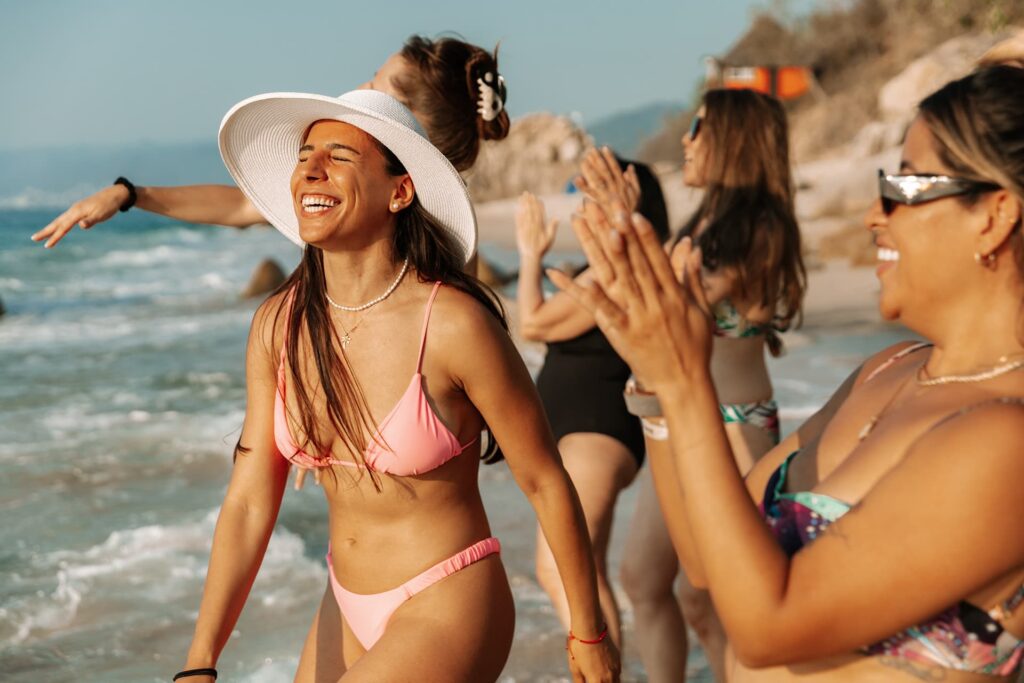
Ask women who’ve taken a solo retreat what they remember most, and it’s rarely the thread count. It’s the conversation at dinner with a stranger who, by day three, doesn’t feel like one.
This dynamic has picked up an informal name in the wellness travel world: soft networking — low-pressure, structured connection woven into the rhythm of the retreat itself, rather than left to chance. Community dining tables and shared group activities create natural, repeated points of contact with the same small group of people, without requiring anyone to perform sociability.
For women specifically, retreats with women-only or women-majority guest bases tend to accelerate this. Conversations move faster and go deeper when the usual social dynamics of mixed-gender group settings aren’t in the room. Women arrive alone and, more often than not, leave with a handful of people they’re still in touch with months later.
07 — THE BARRIER
You Don’t Need to Practice Yoga
This is worth stating plainly, because it’s the single biggest barrier that keeps first-timers from booking: you do not need yoga experience to go on a yoga-centered retreat.
The data supports this shift in who’s actually showing up. Millennials and Gen Z now make up roughly 55% of yoga practitioners, and a growing share are total beginners rather than longtime practitioners deepening an existing practice. Retreat guides increasingly recommend well-run beginner retreats keep groups under 15 people specifically so instructors can offer real modifications—not just say “all levels welcome” and mean it loosely.
Across recent retreat surveys, 98% of attendees report experiencing at least one lasting benefit from their retreat, and 51% specifically cite improved mental and emotional wellbeing. Flexibility barely factors into it. What people actually walk away with is a body that feels less braced, and a mind that’s had a few days of practice sitting still.
08 — SAFETY
Is Mexico Safe for Solo Wellness Travelers?
This is the question most first-time travelers actually type into Google, so it deserves a direct, current answer rather than reassurance for its own sake.
CURRENT ADVISORY — MAY 2026
The U.S. State Department rates Mexico overall as Level 2, “Exercise Increased Caution” — the same level assigned to countries like France and the United Kingdom. Jalisco, the state where Puerto Vallarta sits, carries a Level 3 “Reconsider Travel” designation due to crime and kidnapping risk elsewhere in the state. The advisory is specific on this point, however: it explicitly states there are no travel restrictions in Puerto Vallarta (including neighboring Riviera Nayarit), the Guadalajara metropolitan area, Chapala, or Ajijic. The concerns driving the state-level rating are concentrated in inland and rural areas, not the tourist corridor along the bay.
Puerto Vallarta welcomed more than 6.26 million visitors in 2025 and maintains a visible, well-resourced security and tourist-police presence in its main visitor areas. Practically, the same commonsense precautions that apply to any unfamiliar destination apply here: use registered transportation or rideshare apps rather than hailing taxis on the street, stay aware of your surroundings after dark, and register your trip with the State Department’s Smart Traveler Enrollment Program before you go.
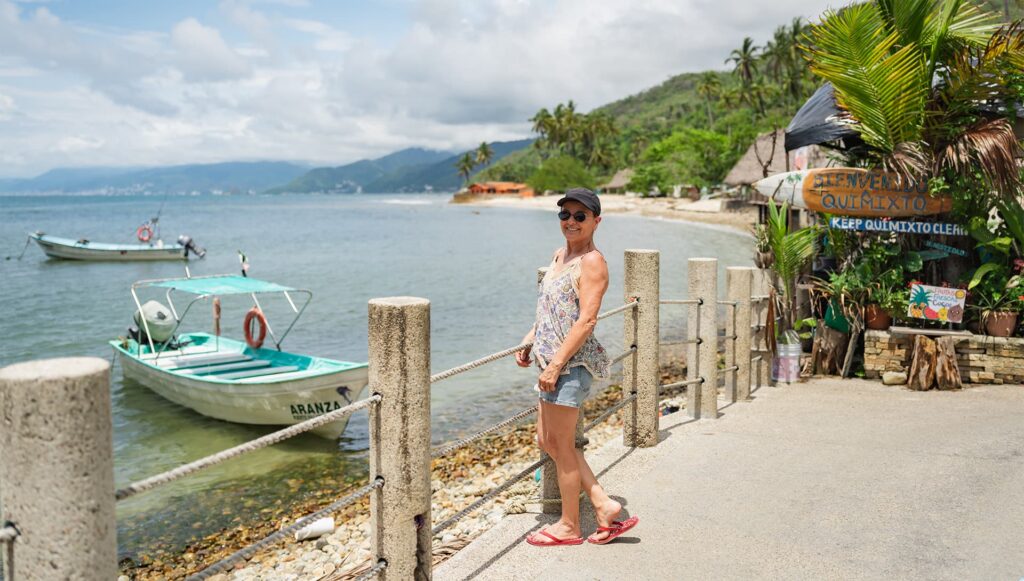
A destination reachable only by private boat adds a layer most guidebooks don’t mention: it removes the need to navigate unfamiliar roads or transportation after dark entirely, because there isn’t a road to navigate.
09 — THE DESTINATION
Why Puerto Vallarta Has Become a Wellness Destination
Puerto Vallarta’s geography does a lot of the heavy lifting here.
Backed by the Sierra Madre mountains and fronted by the Bahía de Banderas, it offers something genuinely rare: jungle and ocean in the same frame, twenty minutes from an international airport, without requiring the multi-flight itinerary that reaching comparable settings in Southeast Asia or the South Pacific would demand.
That accessibility — short flights from most major U.S. and Canadian hubs, English widely spoken in tourist areas, a familiar currency exchange rate — lowers the barrier to a first solo international trip considerably. You get the psychological distance of “somewhere else” without the logistical complexity that can make a first solo trip feel like too much to plan alone.
10 — THE BLUEPRINT
What Makes a Retreat Actually Work
Not every wellness retreat delivers on what it promises.
The difference usually comes down to structure, not amenities. A retreat that actually works for first-time solo travelers tends to combine a few specific elements:
- A boat-access-only or otherwise secluded location, which removes the temptation to duck into “normal life” mid-trip.
- Daily yoga with real modifications offered, not just posted on a schedule.
- Community dining that puts guests at shared tables by default, not optional ones.
- A genuine mix of structured and unstructured time — workshops, sound healing, or a temazcal ceremony alongside long stretches with nothing scheduled at all.
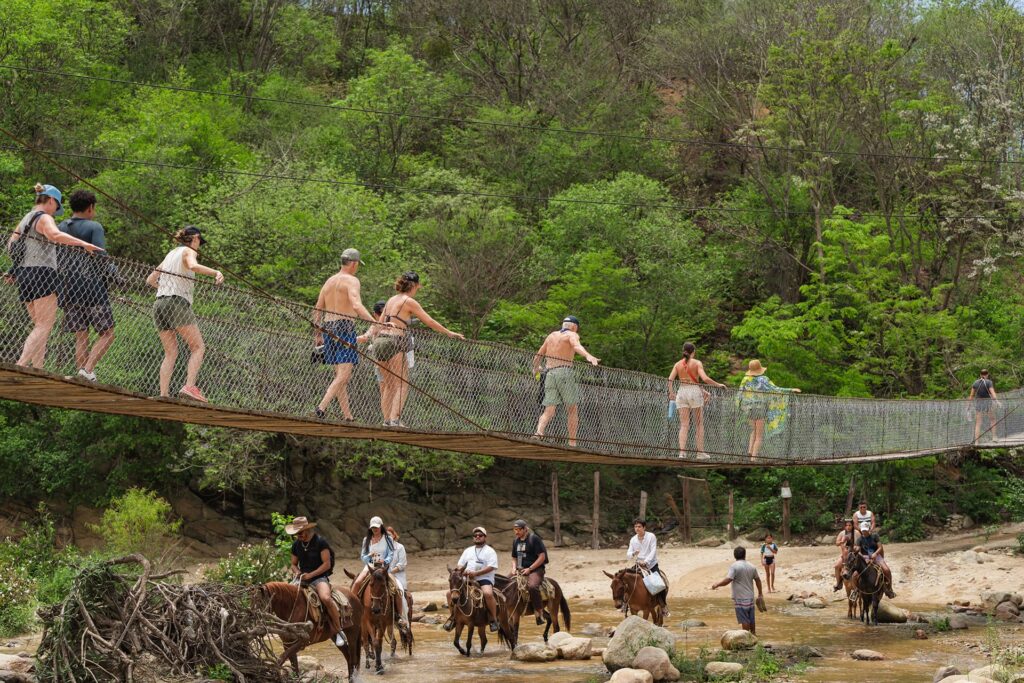
- Access to nature-based movement — hiking trails, paddleboards, kayaks — for people who process stress through the body rather than stillness.
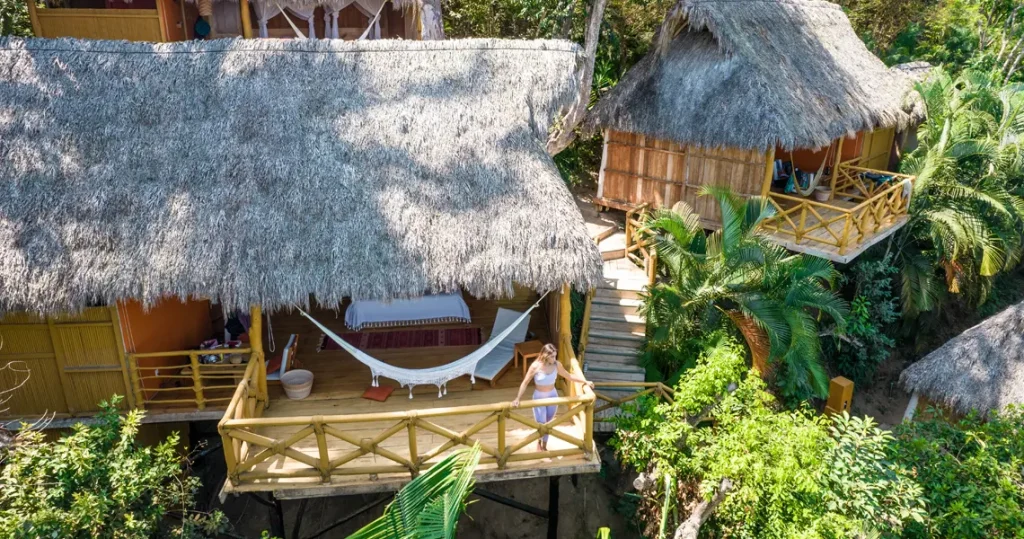
- Oceanfront or jungle-facing accommodations that make the natural setting part of the room, not just the view from it.
- Enough space between guests that “alone” and “lonely” don’t become the same thing.
The through-line across all of it: guests should never have to manufacture their own recovery. The retreat’s job is to remove decisions, not add them.
11 — THE DECISION
Is This the Right Time for Your First Solo Retreat?
If you’re weighing this, it’s worth being honest about what’s actually being asked. It’s not “am I brave enough to travel alone.” It’s closer to: do I trust myself enough to spend several days with only my own company, in a place designed to make that easier rather than harder?
For a woman in her 40s or 50s who has spent two decades being the person everyone else relies on, the calculus is often about permission — not logistics. The trip itself is rarely the hard part. Deciding she’s allowed to take it is.
For a woman in her late 20s or 30s building a career or creative practice on her own terms, the calculus is closer to alignment — finding a trip that matches the kind of traveler she already is: someone who wants nature, authenticity, and people worth talking to, not a resort that could be anywhere.
Both are answering the same underlying question with a yes. A majority of women who take a solo trip after 50 go on to say it’s become their preferred way to travel — evidence that this instinct, once acted on, tends to stick.
12 — CLOSING
Final Reflection
Solo wellness travel isn’t a trend because women suddenly became brave. It’s a trend because a lot of women did the math on what rest actually requires, and realized it rarely happens by accident, at home, in the gaps between everything else.
Taking a week for yourself isn’t the indulgent version of your life. For a lot of women, it’s turned out to be the corrective one.
Frequently Asked Questions
Is it safe for a woman to travel alone to Mexico?
Mexico’s overall U.S. State Department advisory sits at Level 2 (Exercise Increased Caution) as of May 2026—the same level as many popular European destinations. Puerto Vallarta specifically is exempted from Jalisco state’s higher-level advisory and maintains a strong tourist security presence, though standard precautions like using registered transportation apply.
Do I need yoga experience to go on a yoga retreat?
No. Well-designed beginner-friendly retreats keep groups small enough that instructors can offer real modifications, and a growing share of retreat guests worldwide are first-timers rather than experienced practitioners.
Will I feel lonely on a solo wellness retreat?
Most retreats are structured specifically to prevent this—community dining, group excursions, and shared common spaces create natural points of connection without requiring guests to socialize on demand.
What’s the difference between a solo vacation and a solo wellness retreat?
A vacation is typically built around sightseeing and activity. A wellness retreat is built around a recovery-oriented rhythm—movement, rest, unstructured time, and community—designed to lower stress rather than fill a schedule.
How long should a first solo retreat be?
Retreat planning guides commonly suggest four to five days for a first-timer—long enough to genuinely settle in, short enough that a mismatch doesn’t cost you a full week.
Why are so many women choosing women-only or women-majority trips?
Surveyed first-time solo travelers report that a women-only, small-group structure makes them significantly more likely to book a first trip, and conversations at these retreats tend to move faster and go deeper without mixed-gender group dynamics.
What is a digital detox retreat, exactly?
It’s a trip designed around intentional disconnection from screens—often supported by limited cell signal or remote access—so that logging off is structural, not just a personal choice you have to enforce.
Is Puerto Vallarta or a boat-access-only property better for a first solo trip?
A boat-access-only setting removes the option of slipping back into ordinary routines mid-trip and eliminates the need to navigate unfamiliar roads after dark, which some first-time travelers find reassuring rather than restrictive.
What should I actually expect to feel during a solo wellness retreat?
Most people report an adjustment period in the first day or two—an unfamiliar restlessness without a phone or schedule to fill—followed by a shift toward calm. Retreat surveys report the large majority of attendees experience at least one lasting benefit.
How do I know if a wellness retreat is legitimate versus overhyped?
Look for concrete structural details rather than vague wellness language: named instructors, small group sizes, a clear daily rhythm, and specifics about what a typical day actually includes—not just a list of amenities.
External Authority Sources
Global Wellness Institute — Global Wellness Economy Monitor 2025
Grand View Research — Solo Travel Market Report, 2026–2033
Solo Female Travelers Club — 2026 Solo Female Travel Trends Survey
U.S. Department of State — Mexico Travel Advisory
BookRetreats — State of Retreats 2026 Report
Yoga Alliance — Cited via BookRetreats retreat research
Hilton — 2025 Hilton Trends Report
Statistics were verified against original or primary reporting sources as of July 2026. Travel advisories change; readers planning a trip should check travel.state.gov directly before booking.
“If any part of this sounds like where you are right now, it might be worth looking at what a few unhurried days somewhere like this could actually do.